Levine is the founder of the Against the Stream Buddhist Meditation Society, which has centers in East Hollywood and Santa Monica and more than 20 affiliated groups nationwide. He and his students practice a unique incarnation of Buddhism infused with punk rock's anti-establishment ethos. They call themselves Dharma Punx.
Dharma Punx don't wear robes and they don't bow to statues of the Buddha. Anyone can form a group -- as long as he checks with Levine first -- and there isn't the emphasis on hierarchy found in many forms of Buddhism (there are no Zen masters or Tibetan lamas). The idea, Levine said, is to make Buddhist teachings accessible to punks -- and to reconnect Buddhism with what he sees as its radical roots.Both punk rock and Buddhism, according to Levine, began as a rebellion against the status quo. "The first noble truth of Buddhism is that there is suffering in life, that there is an unsatisfactory quality to living in a world where everything is constantly changing, and to living in a world where there is so much greed and hatred and delusion," he said. "Punk rock's foundation is dissatisfaction, acknowledging greed, hatred and delusion and rebelling against sexism, racism, political corruption and war."

Custom Search
Showing posts with label life. Show all posts
Showing posts with label life. Show all posts
Sunday, May 3, 2009
Against the Stream - Dharma Punx
The Los Angeles Times features an article about Noah Levine, founder of the Against the Stream Buddhist Meditation Society.

Saturday, May 2, 2009
Dharma Drum for Young People Summer Retreat
 I was sent an email about a summer retreat opportunity from Venerable Chan Yu of Dharma Drum for Young People. Here is his attached message:
"Dear Friends,
I am writing to announce an opportunity for college students and young professionals to attend the Chan Summer Retreats for Young People. The retreats are sponsored by Dharma Drum for Young People (DDYP), an affiliate ofUS-based *Dharma Drum Mountain Buddhist Association* (DDMBA). DDYP offers the retreats as an opportunity to introduce undergraduate and graduate students, and young professionals to the benefits of meditation and the practices of mindfulness living. Membership or affiliation with DDYP is not required.
The Summer Meditation Retreat for Self-Discovery (for beginners and non-beginners) will be held August 12-15 and the Chan Meditation Summer Retreat (for past participants) will be held August 15-18. The retreats will take place at the Dharma Drum Retreat Center in Pine Bush,
More information and the retreat application can be found at: www.ddyp.org and for the retreat center, visit www.dharmadrumretreat.org. "
Wednesday, March 4, 2009
Buddhist Recovery Network
I found this from a pretty neat blog: dharmadoctors.org.
"Dharmadoctors.org is dedicated to serving health care providers by providing Buddhist resources and inspiration for the enhancement of their practices and the benefit of their patients. Both Medicine and Buddhism are fundamentally concerned with alleviating suffering, and a dialogue between these two great traditions seems not only natural, but of particular relevance in today’s climate of health care crisis."One of their recent entries that I found interesting is on The Buddhist Recovery Network.
"The Buddhist Recovery Network supports the use of Buddhist teachings, traditions and practices to help people recover from the suffering caused by addictive behaviors. Open to people of all backgrounds, and respectful of all recovery paths, the organization promotes mindfulness and meditation, and is grounded in Buddhist principles of non-harming, compassion and interdependence. It seeks to serve an international audience through teaching, training, treatment, research, publication, advocacy and community-building initiatives."
What is your concept of eternity?
Ah, my favorite type of articles. The News & Observer features "Voices of Faith", in which Rev. R.L. Baynham, pastor of Metropolitan Baptist Church, and Lama Chuck Stanford of the Rime Buddhist Center & Monastery provide insight from their respective faiths. In this article, they discuss "What is your concept of eternity?"
Rev. R.L. Baynham: Eternity is an attribute of God, and he alone fathoms its depths. We are challenged to live within the divine purpose of God's will as ascribed in the Bible. When we live in harmony with our purpose, we experience life as it is supposed to be. We understand the purpose is to live a full, meaningful life.
Lama Chuck Stanford: Unlike the monotheistic faiths, Buddhism has no concept of eternity after death. In fact, from the Buddhist perspective, death is viewed as a very temporary state between a nearly infinite number of rebirths.
Read full article.
Rev. R.L. Baynham: Eternity is an attribute of God, and he alone fathoms its depths. We are challenged to live within the divine purpose of God's will as ascribed in the Bible. When we live in harmony with our purpose, we experience life as it is supposed to be. We understand the purpose is to live a full, meaningful life.
Lama Chuck Stanford: Unlike the monotheistic faiths, Buddhism has no concept of eternity after death. In fact, from the Buddhist perspective, death is viewed as a very temporary state between a nearly infinite number of rebirths.
Read full article.
Monday, March 2, 2009
Buddhist lessons from "He's Just Not That Into You"

I've got to watch this movie. Seven buddhist lessons in all, reviewed by The Buddhist Channel. First one:
"1. Some express aversion to those they have attachment to – because they are intimidated by their own attachment, such that they try to reverse it, to reject their attachment. What they really have is aversion to themselves, not the other. Why not try to cultivate equanimity beyond the extremes of attachment and aversion instead?"
For the rest, read full article.
Photo from The Buddhist Channel.
Monday, February 16, 2009
Similarities between Darwinism and Buddhism

From National Geographic News:
Charles Darwin probably didn't know it, but he held views on human empathy that mirror Buddhist beliefs, says a pioneer in decoding facial expressions. Based on his interactions with foreign cultures, Darwin came to define empathy as a desire to end someone's suffering to assuage one's own discomfort. Buddhist teachings also see empathy as a somewhat selfish motivation, but one that the Dalai Lama, the spiritual leader of Tibet, calls the "seed of compassion."
Read full article.
Photo from National Geographic News.
Saturday, February 14, 2009
Darwin and Religion
Feb. 12, 2009, the 200th birthday of Charles Darwin
"Charles Darwin is widely praised by atheists for the way his theory of evolution denies the existence of God. For the same reason he's vilified by conservative religious people.
There is just one problem with the opinions of these opposing camps: They're not exactly based on what Darwin said. The pioneering 19th-century biologist actually confessed that evolution placed him in a "hopeless muddle" about the concept of God.
Church-going Darwin did, indeed, end up rejecting traditional 19th-century views of an Almighty Christian God. He could not accept that an all-powerful Being would willingly cause, as he said, a cat to cruelly play with a mouse."
Wednesday, February 4, 2009
Corporate/Poltical leader now, Asura tomorrow
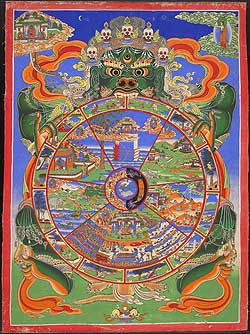 The six realms of Buddhism are rebirth as a deva, an asura, a human being, an animal, a hungry ghost, or a being in Naraka (hell). Can we make any metaphorical connections from these realms to our life here as a human?
O'Brien writes about how being reborn as an asura may very much be like being a corporate or political leader.
"I believe these days most of us (including, I understand, His Holiness the Dalai Lama) do not believe in the Six Realms as actual locations. Instead, they are more often understood as metaphors for our psychological projections. As such, it seems to me the Six Realms teachings shed light on our ongoing financial crisis."
Read full article.
Photo from The Buddhist Channel.
Tuesday, January 27, 2009
Quote from Socrates
I woke up this morning, read this quote, and found it to be an insightful way to start my day.
"I know that I am intelligent, because I know that I know nothing."
-Socrates-
"I know that I am intelligent, because I know that I know nothing."
-Socrates-
Sunday, January 18, 2009
Understanding Death through Buddhism
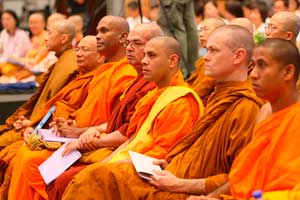
The Closer-to-Reality Conference 2008 was held at Thean Hou Temple from 12/27-12/29. Sasanarakkha Buddhist Sanctuary organized it to “connect real life experiences with Buddhist scriptural understanding”. The conference was titled "Understanding Death and Beyond" and discussed issues such as...
- When does death actually occur?
- If I’m an organ donor, what will happen if I’m not really dead yet but my organs are being harvested?
- Is there really an intermediate state between death in one existence and rebirth in another?
- In a heart transplant, does the ‘spirit’ of the donor share the same body with the recipient who is experiencing a transfer of personality traits?
Photo from The Buddhist Channel.
Wednesday, January 14, 2009
China revives religion
Religion is becoming less taboo and accepted once again as a part of society.
"A government-sponsored survey last year found that 300 million Chinese, or 31.4% of the country’s adult population, considered themselves religious believers, much larger than the government estimate of around 100 million.
Two-thirds of the believers are Buddhists, Taoists or devotees of traditional deities such as the Dragon King or God of Fortune. The survey estimated that 12% of all believers—or 40 million—were Christians, up from 16 million in 2005. That makes Christianity one of the fastest-growing religions in China. Some foreign estimates put the estimated number of Christians even higher, from 50 to 70 million. Many attend independent, unregistered house churches."
So what's the status of Buddhism in China?
"Looking at it from a different perspective, particularly with regard to Buddhism, is Master Xuecheng, vice-president of the Buddhist Association of China, and abbot of four monasteries including the Longquan monastery in Beijing. He argued that once people have satisfied their basic needs and wants such as housing and food, they would have more spiritual demands.
He added: “Only when a society has prospered and developed can it have the strength to tolerate different kinds of thinking…Only after a society has prospered to a certain level can it have considerable numbers of people with relatively high standards of knowledge and, therefore, the qualification to devote themselves to the study of Buddhist scriptures.”
He cited as evidence the fact that Buddhism flourished during ancient China’s golden age, the Tang Dynasty, particularly in the region of Chang’an (present-day Xian), at the Chinese end of the Silk Road.
Liu, who has also explored Buddhism, finds Buddhist scriptures too difficult to grasp. They run into thousands of volumes compared with the one-volume Bible for Christians and the Koran for Muslims.
Besides, Buddhism “requires you to give up a lot in life”, said Liu, adding that she found this hard to accept. Buddhists strive ultimately to chushi, withdraw from the world, she argued."
Wednesday, December 31, 2008
Vegatarian Bodh Gaya Campaign
Tibetans for a Vegetarian Society, a nonprofit public charitable trust, is campaigning for the Bodh Gaya to be a vegetarian zone.
"We are trying to create awareness and mobilise support of locals as well as tourists transforming Bodh Gaya into a vegetarian zone.
Abstaining from buying, selling, or consuming any form of meat during the pilgrimage tour in the holy land is the key to the success of the campaign"
Read full article
"We are trying to create awareness and mobilise support of locals as well as tourists transforming Bodh Gaya into a vegetarian zone.
Abstaining from buying, selling, or consuming any form of meat during the pilgrimage tour in the holy land is the key to the success of the campaign"
Read full article
Wednesday, December 24, 2008
Q: As a Catholic, am I allowed to pray to the Buddha for guidance?
In this article from Buffalo News, Rabbi Marc Gellman answers the question of learning from faiths other than your own. The full question was:
"Q: I’m a practicing Roman Catholic and I recently purchased a book about Jesus and the Buddha. It’s interesting to see that Jesus and the Buddha did say and act in much the same ways, which leads me to ask: As a Catholic, am I allowed to pray to the Buddha for guidance, wisdom and understanding, or is that a big no-no in the eyes of Roman Catholic teaching?
I don’t view or recognize the Buddha as a god, but I do see him as a very holy and wise man, and after all, Catholics pray to saints because they were holy and wise men and women who can intercede for us. — S. "
My favorite part of Rabbi Gellman's answer was:
"Human beings naturally possess different interests, so it’s not surprising that we have many different religious traditions with different ways of thinking and behaving. But this variety is a way for everyone to be happy. If we have a great variety of food, we will be able to satisfy different tastes and needs. When we only have bread, the people who eat rice are left out. And the reason those people eat rice is that rice is what grows best where they live.
So go and study, but remember to eat what grows best where you live."
Read full article.
"Q: I’m a practicing Roman Catholic and I recently purchased a book about Jesus and the Buddha. It’s interesting to see that Jesus and the Buddha did say and act in much the same ways, which leads me to ask: As a Catholic, am I allowed to pray to the Buddha for guidance, wisdom and understanding, or is that a big no-no in the eyes of Roman Catholic teaching?
I don’t view or recognize the Buddha as a god, but I do see him as a very holy and wise man, and after all, Catholics pray to saints because they were holy and wise men and women who can intercede for us. — S. "
My favorite part of Rabbi Gellman's answer was:
"Human beings naturally possess different interests, so it’s not surprising that we have many different religious traditions with different ways of thinking and behaving. But this variety is a way for everyone to be happy. If we have a great variety of food, we will be able to satisfy different tastes and needs. When we only have bread, the people who eat rice are left out. And the reason those people eat rice is that rice is what grows best where they live.
So go and study, but remember to eat what grows best where you live."
Read full article.
Tuesday, December 23, 2008
What does a Buddhist say to the Christmas shopper?
I have posted a few articles on Buddhism and shopping, as we all feel a certain degree of necessity to buy presents for those we care about. But how can we balance all the sales, lines, and gift wrapping with merely enjoying the holidays for what it really represents - a time to recollect and spend time with loved ones at the end of the year.
I found this short but clever and helpful little line from the article "Where Buddha Meets Freud":
Q: What does a Buddhist blogger say to the Christmas shopper?
A: Be the present.
Yes, be the present. Not only does that provide an interesting way of looking at the holidays but it also eliminates all the stress of pushing and shoving through crowds and lining up at stores...the list could go on. May everyone enjoy their holidays.
Read full article
I found this short but clever and helpful little line from the article "Where Buddha Meets Freud":
Q: What does a Buddhist blogger say to the Christmas shopper?
A: Be the present.
Yes, be the present. Not only does that provide an interesting way of looking at the holidays but it also eliminates all the stress of pushing and shoving through crowds and lining up at stores...the list could go on. May everyone enjoy their holidays.
Read full article
Thursday, December 18, 2008
Huffington Post: The Power of Group Meditation
Here's an interesting article from The Huffington Post about rituals (religious and secular) and the experience of practicing meditation or contemplative sitting in a group versus doing it alone. She describes the group experience as "a syncing of individual transformative experiences".
From the brief meditation sittings we do during the University Buddhist Association meetings, I can understand and relate to the power for practicing in a group. It's sometimes very difficult to consistently practice when you do it alone. Being part of a larger group provides motivation, support, and encouragement.
Read full article.
From the brief meditation sittings we do during the University Buddhist Association meetings, I can understand and relate to the power for practicing in a group. It's sometimes very difficult to consistently practice when you do it alone. Being part of a larger group provides motivation, support, and encouragement.
Read full article.
Monday, December 15, 2008
War on Christmas
Here's an interesting article that discusses the "war on Christmas" that some people fight in during the holiday season. The University Buddhist Association at UCLA staff recently experienced something related to this issue in trying to find a holiday card for Venerable Kusala that did not mention "Christmas" or any family relationships (father, mother, son) on it. The result was a really hard time searching through all possible cards but also finding a great card at the end.
Read full article.
Read full article.
Wednesday, December 10, 2008
What would the Buddha buy?
The Buddhist Channel features an interesting article by Gary Gach, the author of The Complete Idiot's Guide to Understanding Buddhism and a member of the International Panel of Advisers for the Buddhist Channel.
So what would the Buddha buy? Here's what Gach has to say:
"What would the Buddha buy? Not too much, not too little. Picture him with his own reusable grocery bag slung over his shoulder, talking to a shopper about making mindful choices: “Do you really need it?” “Where does it come from?” “How will it affect the environment when you’re done?” He might have enjoyed celebrating International Buy Nothing Day on November 29 as a spiritual retreat from frantic holiday shopping (the “shopocalypse,” as Reverend Billy calls it)."
"Neither capitalism nor socialism has prevented children from starving in Somalia. We should be trying to base contentment on being, rather than having. Then the question of buying that fourth shirt or that new gizmo on display might be dwarfed by the prospect of creating more space in one’s life by donating your extra stuff. "
So what would the Buddha buy? Here's what Gach has to say:
"What would the Buddha buy? Not too much, not too little. Picture him with his own reusable grocery bag slung over his shoulder, talking to a shopper about making mindful choices: “Do you really need it?” “Where does it come from?” “How will it affect the environment when you’re done?” He might have enjoyed celebrating International Buy Nothing Day on November 29 as a spiritual retreat from frantic holiday shopping (the “shopocalypse,” as Reverend Billy calls it)."
"Neither capitalism nor socialism has prevented children from starving in Somalia. We should be trying to base contentment on being, rather than having. Then the question of buying that fourth shirt or that new gizmo on display might be dwarfed by the prospect of creating more space in one’s life by donating your extra stuff. "
Saturday, November 29, 2008
Interview with Master Sheng Yen

Here's an interview with Chinese Buddhist Master Sheng Yen by the Religion News Service. He is a prominent and influential figure in Chan (or in Japanese, Zen) Buddhism, teaching in America and writing about Buddhism for the West. You can read a short bio at Wikipedia as well as his new more in-depth memoir, Footprints in the Snow. Here are some interesting questions he answered in the interview:
Q. How did you get through the difficult times in your life?
A. There is no problem that cannot be overcome. To use our heart means to understand how we should go about carrying on. To persevere means to try again and again, and do not be worried and afraid. When I was in mountain, living alone, (I) never thought I was alone. I felt that there are many sentient beings and many bodhisattvas (enlightened beings) to help me.
Q. Why is it better for Buddhists to not get involved in politics?
A. This has something to do with Buddhist tradition. The Buddha was a prince who left home and did not want to get involved in politics any more. Politics is necessary for worldly people. But as soon as one is involved in politics, there will be a lot of problems regarding who is right and who is wrong. As a monastic or a practitioner, one should know what one needs to know about politics, but one should not get involved. As soon as one gets involved, one will immediately be sucked into the worldly, secular environment and be tangled up with it. This will obstruct one's cultivation in the practice.
Q. You recently decided to refuse a kidney transplant. Why?
A. Since I am already 80 years old, if a kidney is transplanted to my body, at most it will be used for 20 more years. If it is transplanted to a younger person the function to be fulfilled by the kidney will be greater. Therefore I think it is wasteful to transplant a perfectly functioning kidney into my body.
Q. How did you get through the difficult times in your life?
A. There is no problem that cannot be overcome. To use our heart means to understand how we should go about carrying on. To persevere means to try again and again, and do not be worried and afraid. When I was in mountain, living alone, (I) never thought I was alone. I felt that there are many sentient beings and many bodhisattvas (enlightened beings) to help me.
Q. Why is it better for Buddhists to not get involved in politics?
A. This has something to do with Buddhist tradition. The Buddha was a prince who left home and did not want to get involved in politics any more. Politics is necessary for worldly people. But as soon as one is involved in politics, there will be a lot of problems regarding who is right and who is wrong. As a monastic or a practitioner, one should know what one needs to know about politics, but one should not get involved. As soon as one gets involved, one will immediately be sucked into the worldly, secular environment and be tangled up with it. This will obstruct one's cultivation in the practice.
Q. You recently decided to refuse a kidney transplant. Why?
A. Since I am already 80 years old, if a kidney is transplanted to my body, at most it will be used for 20 more years. If it is transplanted to a younger person the function to be fulfilled by the kidney will be greater. Therefore I think it is wasteful to transplant a perfectly functioning kidney into my body.
Thursday, November 27, 2008
Happy Thanksgiving!
As we come upon Thanksgiving Day and come together for Thanksgiving dinner, let us be reminded of the Five Contemplations and be mindful and thankful of the food we eat:
1.This food is a gift of the whole universe, the Earth, the sky, numerous living beings and much hard work.
2. May we eat in mindfulness and gratitude, so as to be worthy to receive it.
3. May we transform our unskillful states of mind, especially our greed and learn to eat with moderation.
4. May we eat in such a way as to keep our compassion alive, reduce the suffering of living beings, and preserve our planet.
Insights...
While serving our food:
In this food I see clearly the presence of the entirer universe supporting my existence.
Before eating:
Beings all over the Earth are struggling to live. May we practice so that all may have enough to eat.
After the meal:
My plate is empty. My appetite is fulfilled. My heart is filled with gratitude for parents, teachers, friends, and all beings.
5. We accept this food so that we may nourish our brother and sisterhood, strengthen our Sangha and realize our ideal of serving living beings.
All verses above are taken from the Deer Park Monastery.
1.This food is a gift of the whole universe, the Earth, the sky, numerous living beings and much hard work.
2. May we eat in mindfulness and gratitude, so as to be worthy to receive it.
3. May we transform our unskillful states of mind, especially our greed and learn to eat with moderation.
4. May we eat in such a way as to keep our compassion alive, reduce the suffering of living beings, and preserve our planet.
Insights...
While serving our food:
In this food I see clearly the presence of the entirer universe supporting my existence.
Before eating:
Beings all over the Earth are struggling to live. May we practice so that all may have enough to eat.
After the meal:
My plate is empty. My appetite is fulfilled. My heart is filled with gratitude for parents, teachers, friends, and all beings.
5. We accept this food so that we may nourish our brother and sisterhood, strengthen our Sangha and realize our ideal of serving living beings.
All verses above are taken from the Deer Park Monastery.
Subscribe to:
Posts (Atom)

 Posts
Posts


