The Tricycle has posted a notice about a new program called "Adopt a Monk", organized by the Clear View Project. It's goal is to help the Burmese monks and nuns imprisoned from the Saffron Revolution. Here's how it works:
• Contact Clear View Project to choose a monk or nun.
• Send regular letters on his/her behalf to the United Nations, Burmese Generals, & US government.
• Send funds to buy more food & medicine for that monk. (details follow)
• Hold monthly meditations at your center or public vigils in honor of the monk or all imprisoned monastics.
• Send loving kindness to the monks & nuns, their families and the Burmese generals.
For more information, visit the Clear View Project website.

Custom Search
Showing posts with label nun. Show all posts
Showing posts with label nun. Show all posts
Sunday, April 5, 2009

Friday, December 26, 2008
DharmaNet International
I hope everyone is having a safe and happy holiday.
Here is a website recommended to me by Venerable Kusala called DharmaNet International.
"The new DharmaNet is providing an independent, non-sectarian informational and educational resource on Buddhism to the ever-widening world-wide audience of people impacted by Buddhism. While there are hundreds of Buddhist web sites, there is still no seminal, non-sectarian informational and educational web site that presents the full range of the Dharma to those seeking to engage the teachings."
DharmaNet also offers videos in copperation with BDK, of which Kusala and many others are featured:
"In 2005, the Society for the Promotion of Buddhism (Bukkyo Dendo Kyokai) [BDK] initiated a BDK TV Series shown in Southern California. The weekly 15-minute shows featured interviews and teachings from major American Buddhist followers and teachers. In cooperation with BDK, DharmaNet will gradually be adding these programs to this page. Four new and different segments will be previewed each month. We invite the world to share in the Buddha-Dharma through this new means of communication."
For videos, click here.
Here is a website recommended to me by Venerable Kusala called DharmaNet International.
"The new DharmaNet is providing an independent, non-sectarian informational and educational resource on Buddhism to the ever-widening world-wide audience of people impacted by Buddhism. While there are hundreds of Buddhist web sites, there is still no seminal, non-sectarian informational and educational web site that presents the full range of the Dharma to those seeking to engage the teachings."
DharmaNet also offers videos in copperation with BDK, of which Kusala and many others are featured:
"In 2005, the Society for the Promotion of Buddhism (Bukkyo Dendo Kyokai) [BDK] initiated a BDK TV Series shown in Southern California. The weekly 15-minute shows featured interviews and teachings from major American Buddhist followers and teachers. In cooperation with BDK, DharmaNet will gradually be adding these programs to this page. Four new and different segments will be previewed each month. We invite the world to share in the Buddha-Dharma through this new means of communication."
For videos, click here.
Wednesday, December 3, 2008
Chanting prayer ceremony at Bodh Gaya

Starting Monday, hundreds of Buddhist monks and practioners from all over the world gathered in Bodh Gaya for an eleven-day chanting prayer ceremony.
At the Mahabodhi temple, monks and nuns chanted from the "Tipitaka", praying for world peace and prosperity for all living beings. It is said that the Buddha attained enlightenment under the Bodhi tree in Bodh Gaya, where 250 years later, emperor Ashoka built the Mahabodhi temple.
Bodh Gaya is a city in the Indian state of Bhihar.
Friday, October 17, 2008
Catholics attracting youth
Here's an interesting article about how Catholicism is working to attract the youth. Despite a continuously declining Catholic monastic life, new religious communities have formed as part of a reform in rethinking the Vatican II document dealing with monasticism.
"One such community with a young population, nestled in the Ozarks, is a place that could symbolize Catholicism's true hope for renewal in our time. Founded in 1999, the Clear Creek Monastery has grown from 13 to 30 monks who are intent on building a community that will "last for a thousand years." Clear Creek is also part of the "reform of the reform," a rethinking of Vatican II that has led a number of religious orders—such as the Dominican Sisters in Nashville, the Sisters for Life in New York, and Benedict Groeschel's Franciscan Friars of the Renewal—to rediscover their original mission and flourish."
"The growth in these orders provides a striking contrast to the continuing decline in Catholic monastic and religious life generally. In 1965, there were twice as many religious priests and brothers as today. There are just one-third as many nuns. According to Sister Mary Bendyna, executive director of the Center for Applied Research in the Apostolate at Georgetown University, the average monk is in his early 70s, the average nun in her mid-70s. The mission of many orders has become simply caring for their aging populations as they sell properties and consolidate with others. "
"The emergence of Clear Creek and other growing monastic communities suggests there will always be young people who ask whether their devotion to God should take precedence over their own personal ambitions and even the natural desire for a family. (The A&E special
God or the Girl was an insightful documentary about this.) Today's young people, who have grown up in a highly commercialized and manipulated landscape, are particularly eager to connect with a more authentic way of living. Far from being pressured into pursuing religious vocations, they find their families often protest, feeling they are losing their children to a life that's too isolated."
"One such community with a young population, nestled in the Ozarks, is a place that could symbolize Catholicism's true hope for renewal in our time. Founded in 1999, the Clear Creek Monastery has grown from 13 to 30 monks who are intent on building a community that will "last for a thousand years." Clear Creek is also part of the "reform of the reform," a rethinking of Vatican II that has led a number of religious orders—such as the Dominican Sisters in Nashville, the Sisters for Life in New York, and Benedict Groeschel's Franciscan Friars of the Renewal—to rediscover their original mission and flourish."
"The growth in these orders provides a striking contrast to the continuing decline in Catholic monastic and religious life generally. In 1965, there were twice as many religious priests and brothers as today. There are just one-third as many nuns. According to Sister Mary Bendyna, executive director of the Center for Applied Research in the Apostolate at Georgetown University, the average monk is in his early 70s, the average nun in her mid-70s. The mission of many orders has become simply caring for their aging populations as they sell properties and consolidate with others. "
"The emergence of Clear Creek and other growing monastic communities suggests there will always be young people who ask whether their devotion to God should take precedence over their own personal ambitions and even the natural desire for a family. (The A&E special
God or the Girl was an insightful documentary about this.) Today's young people, who have grown up in a highly commercialized and manipulated landscape, are particularly eager to connect with a more authentic way of living. Far from being pressured into pursuing religious vocations, they find their families often protest, feeling they are losing their children to a life that's too isolated."
Monday, October 13, 2008
Oprah interviews Pema
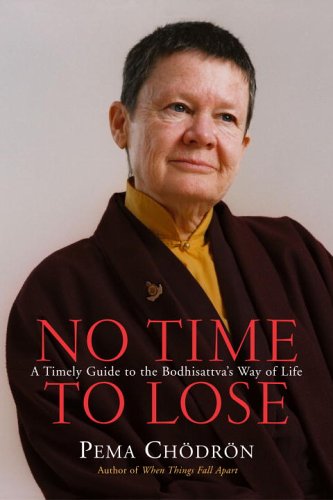
Here is an interview with Oprah and Pema Chödrön, one of the first Western women to be ordained as a Buddhist nun in the Tibetan Vajrayana tradition. She is also an author and holds workshops, seminars, and meditation retreats in helping others apply Buddhist teachings in everyday life. She is currently a resident teacher at Gampo Abbey, a monastery located in Cape Breton, Nova Scotia, Canada. No Time to Lose (shown above) is one of her books.
"Oprah: Yes. And what does it mean to be a Buddhist?"
"Pema: Well, a lot of people might say different things about that, but in my opinion, the essence of it is trusting that the nature of your mind and heart is limitless, boundless, openness, free of prejudice, free of bias, and you could stay in that space and open your eyes and your ears and all your sense perceptions to what's happening without narrowing down into a prejudice or a bias or a view, a kind of solid view that says, no, no, it can't be like that, it has to be like this. So somehow that seems to lead to seeing the humanity of even the worst people and seeing—"
Subscribe to:
Posts (Atom)

 Posts
Posts


