Here's a hilarious video clip from the Colbert Report. During an interview with Paul McCartney, the Beatle suggests that the Dalai Lama would turn to cannibalism as last means of survival. Thanks to Rev. Danny Fisher for posting this.
Colbert Report Video Clip.

Custom Search
Showing posts with label interview. Show all posts
Showing posts with label interview. Show all posts
Saturday, January 31, 2009

Saturday, January 3, 2009
Faith Q&A
Lama Chuck Stanford from Rime Buddhist Center & Monastery and the Rev. R.L. Baynham, pastor of Metropolitan Baptist Church, offer answers from their respective faiths.
Q: Do you think it's possible to have a society that doesn't believe in God and yet is law-abiding and peaceful?
For their answers, please go to the full article.
Q: Do you think it's possible to have a society that doesn't believe in God and yet is law-abiding and peaceful?
For their answers, please go to the full article.
Friday, December 26, 2008
DharmaNet International
I hope everyone is having a safe and happy holiday.
Here is a website recommended to me by Venerable Kusala called DharmaNet International.
"The new DharmaNet is providing an independent, non-sectarian informational and educational resource on Buddhism to the ever-widening world-wide audience of people impacted by Buddhism. While there are hundreds of Buddhist web sites, there is still no seminal, non-sectarian informational and educational web site that presents the full range of the Dharma to those seeking to engage the teachings."
DharmaNet also offers videos in copperation with BDK, of which Kusala and many others are featured:
"In 2005, the Society for the Promotion of Buddhism (Bukkyo Dendo Kyokai) [BDK] initiated a BDK TV Series shown in Southern California. The weekly 15-minute shows featured interviews and teachings from major American Buddhist followers and teachers. In cooperation with BDK, DharmaNet will gradually be adding these programs to this page. Four new and different segments will be previewed each month. We invite the world to share in the Buddha-Dharma through this new means of communication."
For videos, click here.
Here is a website recommended to me by Venerable Kusala called DharmaNet International.
"The new DharmaNet is providing an independent, non-sectarian informational and educational resource on Buddhism to the ever-widening world-wide audience of people impacted by Buddhism. While there are hundreds of Buddhist web sites, there is still no seminal, non-sectarian informational and educational web site that presents the full range of the Dharma to those seeking to engage the teachings."
DharmaNet also offers videos in copperation with BDK, of which Kusala and many others are featured:
"In 2005, the Society for the Promotion of Buddhism (Bukkyo Dendo Kyokai) [BDK] initiated a BDK TV Series shown in Southern California. The weekly 15-minute shows featured interviews and teachings from major American Buddhist followers and teachers. In cooperation with BDK, DharmaNet will gradually be adding these programs to this page. Four new and different segments will be previewed each month. We invite the world to share in the Buddha-Dharma through this new means of communication."
For videos, click here.
Saturday, November 29, 2008
Interview with Master Sheng Yen

Here's an interview with Chinese Buddhist Master Sheng Yen by the Religion News Service. He is a prominent and influential figure in Chan (or in Japanese, Zen) Buddhism, teaching in America and writing about Buddhism for the West. You can read a short bio at Wikipedia as well as his new more in-depth memoir, Footprints in the Snow. Here are some interesting questions he answered in the interview:
Q. How did you get through the difficult times in your life?
A. There is no problem that cannot be overcome. To use our heart means to understand how we should go about carrying on. To persevere means to try again and again, and do not be worried and afraid. When I was in mountain, living alone, (I) never thought I was alone. I felt that there are many sentient beings and many bodhisattvas (enlightened beings) to help me.
Q. Why is it better for Buddhists to not get involved in politics?
A. This has something to do with Buddhist tradition. The Buddha was a prince who left home and did not want to get involved in politics any more. Politics is necessary for worldly people. But as soon as one is involved in politics, there will be a lot of problems regarding who is right and who is wrong. As a monastic or a practitioner, one should know what one needs to know about politics, but one should not get involved. As soon as one gets involved, one will immediately be sucked into the worldly, secular environment and be tangled up with it. This will obstruct one's cultivation in the practice.
Q. You recently decided to refuse a kidney transplant. Why?
A. Since I am already 80 years old, if a kidney is transplanted to my body, at most it will be used for 20 more years. If it is transplanted to a younger person the function to be fulfilled by the kidney will be greater. Therefore I think it is wasteful to transplant a perfectly functioning kidney into my body.
Q. How did you get through the difficult times in your life?
A. There is no problem that cannot be overcome. To use our heart means to understand how we should go about carrying on. To persevere means to try again and again, and do not be worried and afraid. When I was in mountain, living alone, (I) never thought I was alone. I felt that there are many sentient beings and many bodhisattvas (enlightened beings) to help me.
Q. Why is it better for Buddhists to not get involved in politics?
A. This has something to do with Buddhist tradition. The Buddha was a prince who left home and did not want to get involved in politics any more. Politics is necessary for worldly people. But as soon as one is involved in politics, there will be a lot of problems regarding who is right and who is wrong. As a monastic or a practitioner, one should know what one needs to know about politics, but one should not get involved. As soon as one gets involved, one will immediately be sucked into the worldly, secular environment and be tangled up with it. This will obstruct one's cultivation in the practice.
Q. You recently decided to refuse a kidney transplant. Why?
A. Since I am already 80 years old, if a kidney is transplanted to my body, at most it will be used for 20 more years. If it is transplanted to a younger person the function to be fulfilled by the kidney will be greater. Therefore I think it is wasteful to transplant a perfectly functioning kidney into my body.
Thursday, November 13, 2008
The Youth in Buddhism
Here's an excerpt from a BuddhaDharma article about how Buddhism has changed demographically, esepcially in regards to the youth. For the article, Diana Winston, the Director of Mindfulness Education for the UCLA's Mindful Awareness Research Center, interviews four particpants, Sumi Loundon Kim, Rod Meade Sperry, Iris Brilliant And Zoketsu Norman Fischer, as part of a panel discussion.
"Nevertheless, there has been a small but important demographic shift. There are more young people at dharma centers than in the late eighties and nineties. Teen and young people retreats have contributed to broadening the dharma, as have a series of books, websites, and communities targeting young people. There is now a teacher-training program at Spirit Rock where many of the trainees are under forty. Young people are practicing, undeniably, but as Sumi Loundon Kim points out in the panel, they still account for a small percentage of the total population of practitioners."
"Twenty years after my first retreat, I can say that the dharma is absolutely relevant to young people, as this panel shows us. And the inclusion of youth in the future of the dharma will only create a vital, exciting new form of Buddhism(s). The dharma is far from dying out, but its future expressions may take us by surprise. I can’t wait to see what it looks like!"
"Nevertheless, there has been a small but important demographic shift. There are more young people at dharma centers than in the late eighties and nineties. Teen and young people retreats have contributed to broadening the dharma, as have a series of books, websites, and communities targeting young people. There is now a teacher-training program at Spirit Rock where many of the trainees are under forty. Young people are practicing, undeniably, but as Sumi Loundon Kim points out in the panel, they still account for a small percentage of the total population of practitioners."
"Twenty years after my first retreat, I can say that the dharma is absolutely relevant to young people, as this panel shows us. And the inclusion of youth in the future of the dharma will only create a vital, exciting new form of Buddhism(s). The dharma is far from dying out, but its future expressions may take us by surprise. I can’t wait to see what it looks like!"
Monday, October 13, 2008
Oprah interviews Pema
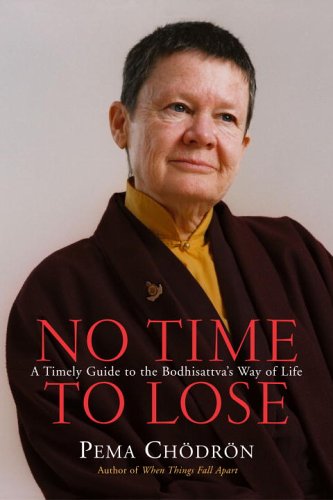
Here is an interview with Oprah and Pema Chödrön, one of the first Western women to be ordained as a Buddhist nun in the Tibetan Vajrayana tradition. She is also an author and holds workshops, seminars, and meditation retreats in helping others apply Buddhist teachings in everyday life. She is currently a resident teacher at Gampo Abbey, a monastery located in Cape Breton, Nova Scotia, Canada. No Time to Lose (shown above) is one of her books.
"Oprah: Yes. And what does it mean to be a Buddhist?"
"Pema: Well, a lot of people might say different things about that, but in my opinion, the essence of it is trusting that the nature of your mind and heart is limitless, boundless, openness, free of prejudice, free of bias, and you could stay in that space and open your eyes and your ears and all your sense perceptions to what's happening without narrowing down into a prejudice or a bias or a view, a kind of solid view that says, no, no, it can't be like that, it has to be like this. So somehow that seems to lead to seeing the humanity of even the worst people and seeing—"
Subscribe to:
Posts (Atom)

 Posts
Posts


