About the UBA

The University Buddhist Association of UCLA is an organization of students, faculty, and community members who come together to learn about and practice Buddhism. We're a non-sectarian Buddhist group that welcomes all Buddhists and non-Buddhist of all faiths and traditions.

If you're interested in learning more about the UCLA Buddhist community, please come to our meetings.

When: Every Tuesday, 5:30 - 7:00pm
Where: University Catholic Center
633 Gayley Avenue
Los Angeles, CA 90024

If you have any questions, please contact us at uba.ucla.online@gmail.com.
Custom Search
Showing posts with label India. Show all posts

Saturday, November 7, 2009

11-year-old becomes high-ranking lama


I wonder when Buddhists found out that reincarnation became globalized...

An 11-year-old schoolboy from Boston, Massachusetts has been made the head of a Buddhist sect in India after he was recognized as the reincarnation of a high-ranking lama who died more than 750 years ago.

Jigme Wangchuk has been anointed as the Rinpoche, the second reincarnation of Gyalwa Lorepa of the Drukpa sub-sect after going into a trance and describing a Buddhist monastery in detail.

Read full article.

Image from Daily Contributor


Wednesday, June 10, 2009

Journey to Zanskar

Screening of Journey to Zanskar

USC, Taper Hall 202
Los Angeles, CA 90089
Free and open to the public
Refreshments will be served
Time: 7:00PM - 9:00PM
Please RSVP:
uschina@usc.edu uschina@usc.edu>

Filmmaker Frederick Marx, producer of Academy Award nominated "Hoop Dreams," will be premiering a rough cut of his new film.

This screening features an advance preview of Journey to Zanskar. The film will be completed and released in the fall. It focuses on Zanskar, in the northernmost part of India, one of the most isolated regions of the Himalayas. Inaccessibility and isolation has protected Zanskar - also known as "Little Tibet" - from cultural change. Today, it is considered the last place on earth where traditional Tibetan Buddhist norms and ways of life still exist. This will change when the Indian government completes a modern paved road into Zanskar to provide its military with access to India's fragile borders with Pakistan and China.

Several years ago the Dalai Lama asked two senior monks upon the completion of their training to devote themselves to educating the children of Zanskar so their rich cultural heritage could be preserved through reading and writing. The two monks selected 17 of the brightest children from among the poorest families and began a ten day trek over the snow covered Himalayas from Zanskar to a school on the other side of the mountains. The children's journey is the focus of the film.

Marx will introduce the film and take questions after the screening.

Parking is available for $8 in Parking Structure D (on Jefferson Boulevard, west of Figueroa Boulevard). Click here to see the USC University Park Campus interactive map <
http://web-app.usc.edu/maps/> .

Project Trailer (
http://www.youtube.com/watch?v=sdkCMqqrlww <http://www.youtube.com/watch?v=sdkCMqqrlww> )
Project Website (
http://www.fmarxfilm.com/17paths.html <http://www.fmarxfilm.com/17paths.html> )
Project Blog (
http://vcr.csrwire.com/node/12341 <http://vcr.csrwire.com/node/12341> )
Project Donation Page (
http://www.fmarxfilm.com/donate.html <http://www.fmarxfilm.com/donate.html> )

Contact: US-China Institute
Phone: 213-821-4382
Email:
uschina@usc.edu

Sponsor(s): USC US-China Institute, Religion, Identity and Global Governance, The Office of Religious Life

Monday, March 23, 2009

The Buddha as Astute Businessman, Economist, Lawyer

I regret not having attended this lecture by Gregory Schopen, chair of the Department of Asian Languages and Cultures and an authority on ancient Indian Buddhism.

"The Buddha was a businessman. But don't take anyone's word for it — it's written in stone.

Of all the iconic scenes found in the earliest Buddhist art from India, none are more striking than the sculpted representation of a title deed involving one of Buddhism's most venerable monasteries: The transaction, involving 10 million gold coins, clearly shows that, far from being an ascetic, other-worldly religious tradition, Buddhism was, in fact, "deeply entangled with money – and a very great deal of it at that," according to Gregory Schopen, chair of the Department of Asian Languages and Cultures and an authority on ancient Indian Buddhism."

Read Full Article.

Monday, March 2, 2009

UCLA Buddhist Scholar Gregory Schopen

From our very own UCLA:

"As one of the world's leading authorities on Buddhism, Gregory Schopen has shattered many myths, notably the notion that Buddhist monks in ancient India renounced money and property.

Schopen finds the widespread Western fascination with Buddhism "highly artificial and a little bit silly because it takes place completely in the abstract." The average Westerner is not interested in the "totality of what Buddhism is – a way of interacting and being human – but with a certain set of free-floating ideas that have been connected with Buddhism," he explained, adding: "I have a problem with that."

One of his favorite images of Buddhism as it's practiced in America is from a photograph of devotees in a Thai Buddhist temple in Los Angeles: "All the local Thai people are doing worship to the Buddha image in the front; in the back is a whole row of white guys meditating," said Schopen. "These are completely different approaches to the same phenomenon – the picture is worth a thousand words."

Read full article.

Wednesday, December 31, 2008

Vegatarian Bodh Gaya Campaign

Tibetans for a Vegetarian Society, a nonprofit public charitable trust, is campaigning for the Bodh Gaya to be a vegetarian zone.

"We are trying to create awareness and mobilise support of locals as well as tourists transforming Bodh Gaya into a vegetarian zone.

Abstaining from buying, selling, or consuming any form of meat during the pilgrimage tour in the holy land is the key to the success of the campaign"

Read full article

Wednesday, December 3, 2008

Chanting prayer ceremony at Bodh Gaya


Starting Monday, hundreds of Buddhist monks and practioners from all over the world gathered in Bodh Gaya for an eleven-day chanting prayer ceremony.

At the Mahabodhi temple, monks and nuns chanted from the "Tipitaka", praying for world peace and prosperity for all living beings. It is said that the Buddha attained enlightenment under the Bodhi tree in Bodh Gaya, where 250 years later, emperor Ashoka built the Mahabodhi temple.

Bodh Gaya is a city in the Indian state of Bhihar.

Thursday, November 20, 2008

Tension among Tibetan leaders


Tibetan leaders, politicians, and activists are participating in a week-long summit in Dharamsala, India, to discuss the future of Tibet without the leadership of the Dalai Lama. After the Dalai Lama announced that he has given up negotiations with China, he leaves the future of Tibet into the hands of the Tibetan people. However, the conservatives supporting further talks are in conflict with the young radicals fighting for a free Tibet.

Time magazine writes about the summit.

"The meeting, Barnett says, is 'explicitly a response by the Dalai Lama to criticism that his charisma has cramped any space for real discussion.' But no one is expecting Tibetans to suddenly shift course from the 'middle path,' which advocates for negotiating with Beijing for autonomy, not independence, and has been steered so carefully by their spiritual leader for the past 30 years. Instead, the summit will be considered a success if it reaches some consensus on how to choose the Dalai Lama's successor', and if it brings Tibetans together to discuss issues like education and how to involve young Tibetans in the political process. Barnett notes that China may find it more difficult to control a movement that is strong and unified around a common purpose. 'If they can achieve that, it will really be quite significant,' he says. And perhaps the most radical move of all. "

Wednesday, October 1, 2008

Buddhist pilgrimage sites

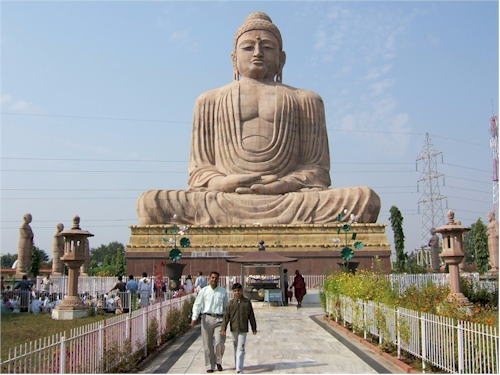
I learn something new everyday from writing this blog and here's something new about Buddhism I didn't know before. This article lists seven historically important Buddhist sites that people can visit. The image above is a picture of the first site listed on this article, Bodhgaya. It is there that the Buddha attained his enlightenment.

"India is the country where the seeds of Buddhism were first sown. It was here that Lord Buddha first propagated the doctrines of this noble religion. There are around 16 Buddhist pilgrimage sites, among which 4 deserve a special mention for their religious importance. Embarking on Buddhist tours will make you have an idea of the origin and growth of the religion in the country. Some of the renowned pilgrimage sites of Buddhism are located in the Ganges Valley in the northern part of India. It is in these places that Lord Buddha imparted his first teachings on the doctrines of Buddhism."